

A Rorschach Test On AI Art
What does our reaction to AI-generated art say about us?

The Monet Experiment
What is your reaction to this?


Do you think AI did a good job imitating Monet? Were you able to find the flaws in the AI attempt at mimicking him? Are you appalled by AI imitating the great artists or making “art” at all?
Here’s what people said in the comments about SHL0MS’ tweet.


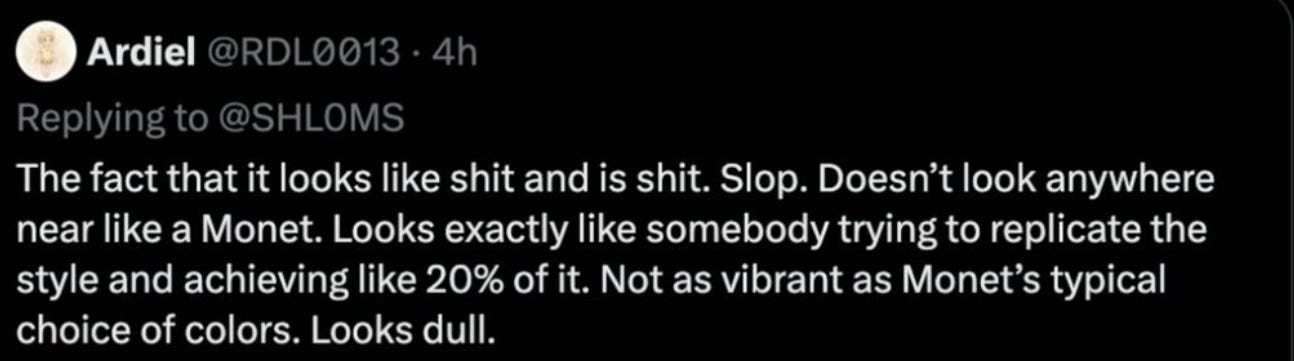
The interesting thing about SHL0MS’ post is that the painting is actually not an attempt at replicating Monet’s style. Instead, it’s the image of an actual Monet painting, titled Water Lillies (Les Nymphéas), and was created by him in 1919.
Here are more reactions if you’re interested.


What Does This Tell Us About Us?
Our emotions drive our perception, not just our reactions.
Per philosopher David Hume, “Reason is, and ought only to be the slave of the passions, and can never pretend to any other office than to serve and obey them.” In other words, our emotions tell us how to feel about something and then we find reasons to support that view. And those emotions don’t just shape our conclusions — they shape what we see in the first place.
Many commenters do not like AI created art and so they find “flaws” in order to “rationally” react negatively to it. If we expect to see great art, we find the nuances and touches that make it great art. If we expect to see what we might think of as “an AI knock-off”, we see the flaws and errors that make it subpar. This should concern us, because it means our observations about the world are filtered by our preconceptions about things. This happens not only in the art field but also in arenas such as politics, investing, and HR decisions.
We are far more socially influenced than we admit.
I imagine many posters looked at what others said in reaction to the “fake” Monet and decided to pile on with criticism. I’ve experience something similar when I present on AI. I will play an AI-generated song produced by Suno, a company that creates music via human prompts. After playing it, I then ask the audience what they think. Most audiences actually like the music. However, I noticed in younger groups where peer pressure is high, the students look around the room and, based on their peers’ hand raising, decide it’s not good. Our judgments shaped not only by our own biases. They are also actively shaped by what we think others expect of us.
We react before we verify, and AI exacerbates this flaw.
A quick and simple Google search would have informed the commenters that what they were seeing was not AI art but an actual Monet. Instead of taking a moment to research and find the facts, most commenters had a reflexive “ick” response that was actually unwarranted.
We are not very good at telling the difference between AI-generated content and human-created works. This applies not only to creative content, but to videos and images on the internet and social media. Half of voters polled said when it comes to political news and the media, it’s becoming too difficult for them to tell what is true and what is false. Furthermore, 54% agreed with the statement, “I’ve disengaged from politics because I can’t tell what’s true.”
In an era of fake AI, we must suspend judgement until we’ve done the work to understand where truth lies. If we are to avoid throwing up our hands and suspending judgement on everything, we will need to take the time and effort to find out if what we are seeing and hearing is real or not.
Provenance and meaning will matter more as AI improves.
If we judge AI artwork by the awards it wins when it’s not labeled as AI, it appears to do a pretty good job of creating art. And if we judge AI music by downloads, it’s also quite good. Yet when people know AI creates something that we think of as requiring a human touch, many tend to react negatively to it.
When discriminating people buy expensive brands, the backstory and origin, i.e., the provenance, of the brand matters. It’s important to them that their champagne comes from a specific region in France or their Ferrari comes from Marinello, Italy.
The same is now true with creative content. For some people, they strongly desire certain content, e.g., art, music, video, to be made completely by humans. The technical capability of AI might match that of humans, but the fact it was made by a person overrules that.
On the production side, the burden of proof that one has produced something oneself and not used AI has not only increased, it has in some instances become impossible to prove the negative. This impacts not only art, but homework, photography, journalism, university research, legal evidence, and even personal emails and phone calls.
We humans do not perceive images directly. Instead, we perceive stories, intentions, status signals, social expectations, and cultural narratives. The painting itself was real but the explanatory frame changed. Yet the emotional and intellectual response changed dramatically. We consume not just the creative work but all the symbolism and provenance behind it.
For Us, Meaning is Important
Before we too quickly condemn these all-to-human tendencies as terrible human failings, it’s worth pausing. Caring where something comes from isn’t irrational bias. Even if a creation is technically perfect, technique by itself is insufficient. We should and do care about who created it, why they made it, and what they sacrificed to make it. It reflects something genuinely important and valuable to us as humans. When we learn that Monet painted Water Lilies in his seventies, nearly blind, still driven to capture light on water, that context deepens the meaning of the piece. Putting a premium on provenance and meaning-making aren’t bugs in our human software, but features.
The question, then, is not how to eliminate these tendencies but how to keep them aligned with reality. The problem with the commenters wasn’t that they cared about whether the painting was human-made. That’s totally understandable and legitimate. The problem was that they skipped the step of finding out whether it actually was made by AI. Our goal shouldn’t be to be indifferent to the origin of creative works. It should be that we care enough to be rigorously learn the facts before we make our judgment.
In Closing.
The Monet experiment exposes something both humbling and clarifying. It tells us we are not the objective, rational observers we believe ourselves to be. Instead, we are meaning-making creatures, and meaning is inseparable from context, story, and social pressure. In a sense, that’s one of the beautiful parts of being human.
However, in an age when AI can generate a painting, a song, a video, or a news story indistinguishable from the real thing, our meaning-making machinery can be hijacked. We react before we research. We conform before we question. We condemn what we cannot verify and trust what flatters our existing beliefs. These tendencies were always with us. Unfortunately, AI has turbocharged their consequences. To deal with that, we must return to the old-fashioned discipline of slowing down, doing research, and investigating the source before passing judgment. We must go beyond the labels to understand the origin.
Mark McNeilly is a Professor of the Practice at UNC Kenan-Flagler Business School, chairs the UNC Provost’s AI Committee and is an Advisor for QuantHub, an AI firm. He writes on AI, leadership, and strategy at Mimir’s Well on Substack.
This article was written by me and improved with additional input from AI.