

AI and The Soft Soap Problem
How Companies Mistake AI Adoption for AI Innovation

“The best, maybe the only, real, direct measure of innovation is change in human behavior.”
Stewart Butterfield
Former CEO - Slack
This week we saw how Anthropic’s move into offering industry specific AI software via Claude Cowork hammered software stocks, putting companies with old business models in a tough spot.
The meme below does a great job visualizing this problem. What many companies are doing is what you see on the left instead of the right. Rather than rethinking their business from the ground up with AI as a base assumption (the soft soap), they are taking the new AI technology (the pump) and sticking it into their old business model (the hard soap).
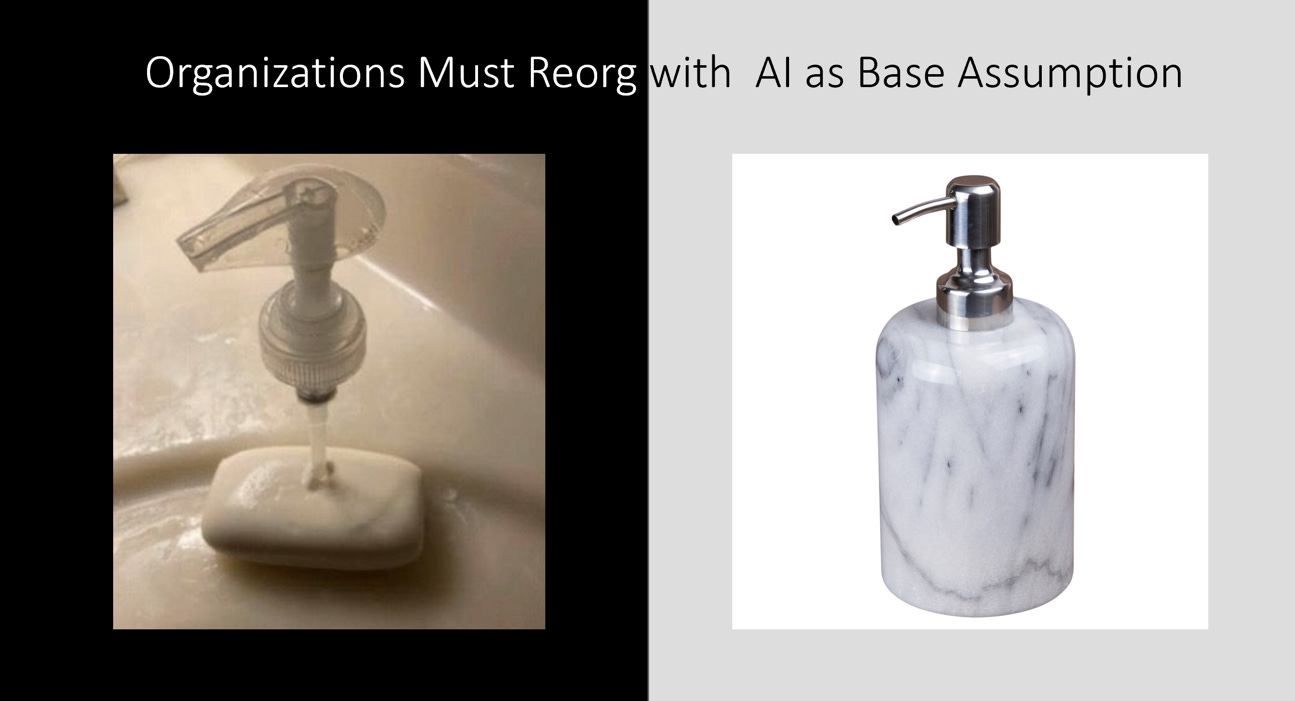
Per the quote above from Stewart Butterfield, the leaders of these companies and others are not fundamentally changing the behavior of their firms.
Let’s look at a concrete example. I was recently on a panel to discuss the impact of AI on the media industry. When asked, “what should news media companies do to adapt to an AI-centric world?”, I brought up the soft soap example and added, “what media companies are doing now is just sticking AI into a few different places and calling it good. Instead, they need to start by asking themselves, ‘what roles in the company can AI play, use those as the base, and then add humans to perform the other roles.’”
Let’s see what that might look like.
Rethinking a News Media Firm
The table below provides a high-level view of how a news company could rethink its business model.
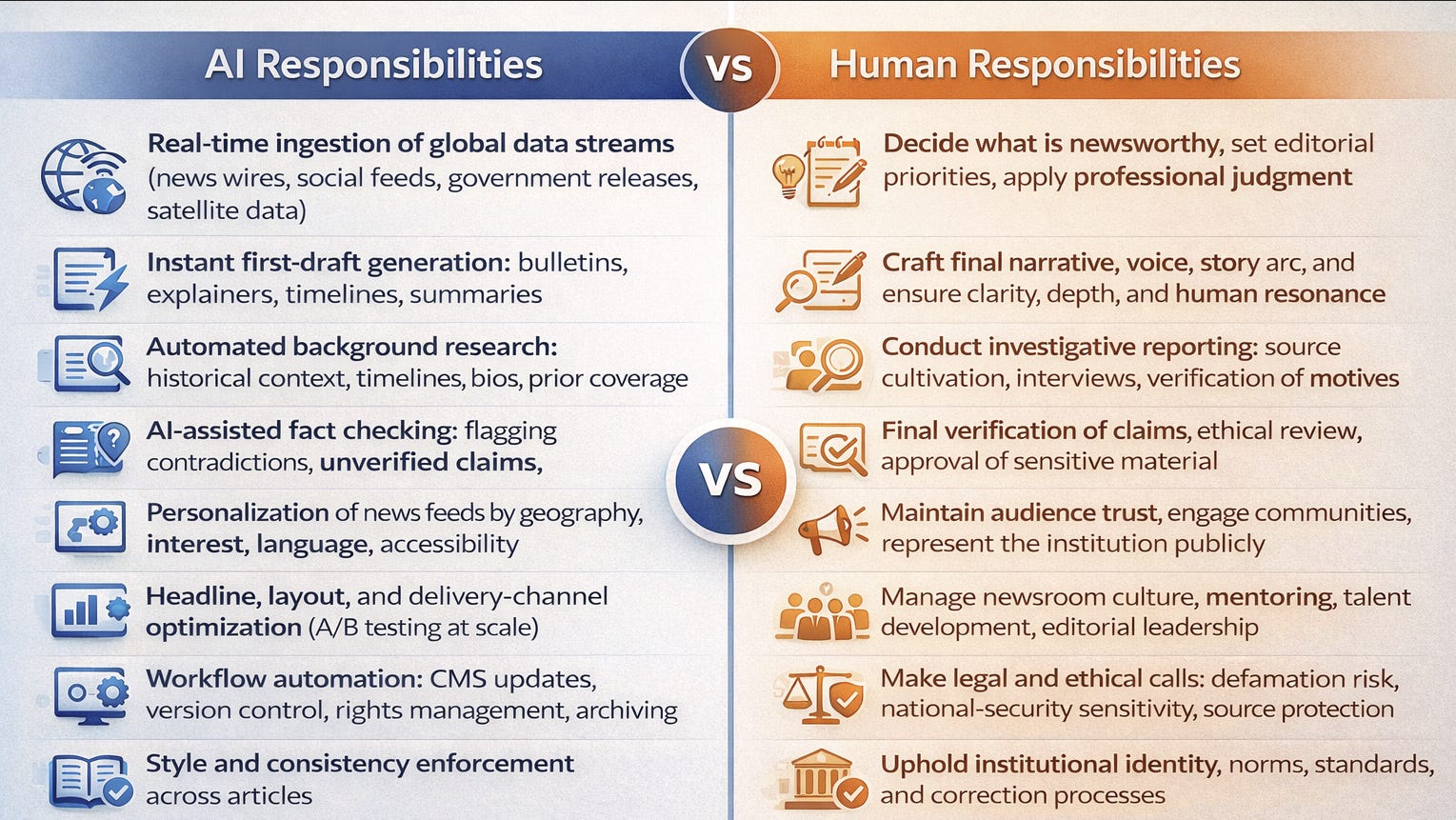
For example, AI could pull data from several, different news sources and provide summaries to an editor, who decides what is worth publishing. Of course, AI could offer recommendations on what might be a priority, but the human would make the final call.
For a reporter, AI might assist in much of their research and perhaps offer leads to follow-up, with the reporter then digging deeper to get more background and doing interviews (of course, recording them with AI). Then the reporter would use AI to as a thought-partner to bounce ideas off and suggest next steps.
AI might create different editions for different target segments, while the editors work to build relationships with various communities, and feed that back into the AI to improve its personalization.
The AI could create layouts and ensure style consistency throughout the editions, with humans deciding on the overall identity, look and feel.
The resulting firm would look very different from firms today; they would have a very powerful AI interacting symbiotically with a smaller but more empowered organization of people.
How To “Soft Soap” Your Business Model
There are various ways to rethink your business with AI as the base and building the human element around that.
One is to get your team together and brainstorm on the problem. Another is to prompt AI with, “If I were to reinvent a ________ organization with AI as the base assumption, using AI doing what it does best and humans doing what they do best, what things would AI do and what would the humans do? Break the two roles out side by side.” Probably best is to use the “Centaur” model (using humans and AI together) and do a joint human & AI brainstorming exercise.
No matter which path your organization takes, its leaders need to get started now. Stewart Butterfield’s observation gives us a simple diagnostic. If you haven’t rethought your business model for AI, then real innovation hasn’t occurred—no matter how many AI tools it has adopted.
The future will belong not to firms with AI everywhere, but to firms that behave differently because of it.
Mark McNeilly is a Professor of the Practice at the University of North Carolina, chairs the UNC Provost’s AI Committee, speaks widely on AI and leadership, and is the author of three books with Oxford University Press, including, Sun Tzu and the Art of Business: Six Strategic Principles.
Really good brainstorm post of an ai news gathering—Bezos should hire you as a consultant to recreate an ai-based WaPo. Or maybe Musk to make GrokWash, or GrokWatch Washington (& NYC, LA, Chicago).
Which is increasingly feasible as so much govt info gets published, hard to wade thru.
Thanks. I'd love to have Bezos hire me but turning around an existing media company would be a tough job. Might be easier to start from scratch.