


Our educational system is built on testing outputs that previously did a good job evaluating competence but that AI can now produce instantly. If we don’t change course, we will graduate students who appear competent but cannot think.
“AI should help you think. Not think for you.”
At the University of North Carolina-Chapel Hill, our philosophy on AI use is that “AI should help you think, not think for you.” It’s an excellent philosophy to evaluate how we are teaching students in the age of AI as well as how we design assignments to ensure academic integrity. It’s also a very useful question for students (and faculty!) to ask themselves when they personally use AI. “Is using AI this way helping me think or am I letting AI think for me?”
That’s the philosophy. Therefore, data from a Quinnipiac survey on AI would indicate that we as educators need to do a better job integrating AI into our pedagogy.
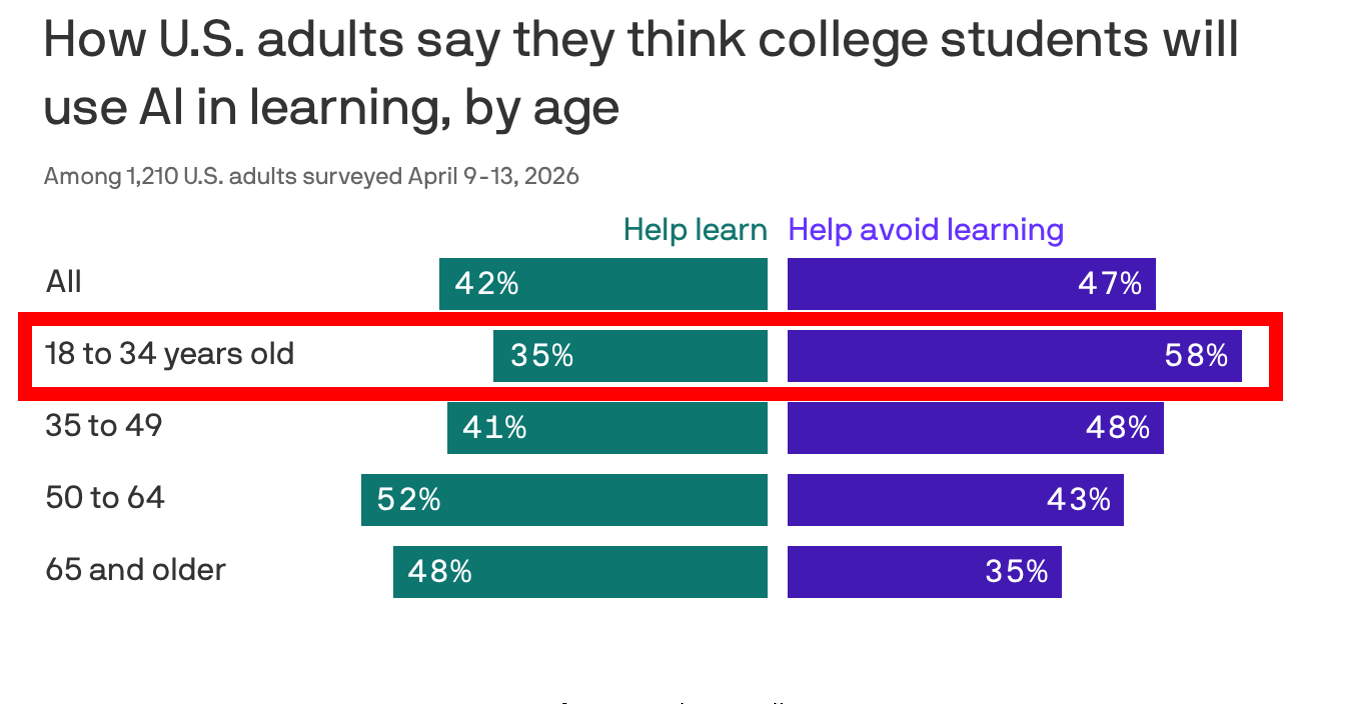
Per Quinnipiac, “Americans were asked whether they think college students are more likely to use AI to help them learn or to help them avoid learning. Forty-two percent of Americans think college students are more likely to use AI to help them learn, while 47 percent think college students are more likely to use AI to help them avoid learning.”
The data by age cohort are even more troubling, as you can see below (graph created by Axios from Quinnipiac data, emphasis mine).
As Quinnipiac Analyst Tim Malloy said,
“Who is most skeptical about the merits of having AI provide a learning assist? By age, the generation most likely to be familiar with the workings of AI in the classroom,”
In sum, the generation that grew up with AI in education is telling us as educators we need to change how we teach in the age of AI.
What is to be done?
If we keep on teaching as we have in the past, students will use AI to avoid learning rather than to deepen it. That is not a student failure but one of pedagogy design. When AI was not a factor, it was fine to build assignments and evaluation systems on the output, since the output required thinking. In an AI world, that approach now fails. If we want AI to help students think rather than think for them, we need to redesign how we teach. Below are some ways we might do that.
Redesign Assignments Around Human Judgment Augmented with AI
Here we can redesign assignments so that AI is part of the process. Instead of banning AI, we can require students use it in ways that still demand human judgment. We could ask students to use AI to generate multiple approaches to a problem, then critique those approaches and synthesize a better one. This could all be done in class to ensure academic integrity. By doing so, we shift the focus from coming up with one answer to how well the student evaluates different options and improves upon what AI produces.Shift from Answers to Decisions Under Uncertainty
In this approach we move away from assignments that have clean, correct answers to decisions under uncertainty. This mirrors real life and is where education should operate. Students can use AI to help generate options and trade-offs, but must make the decision themselves and state their rationale. This is what they will be asked to do in the “real world” so we should replicate that in the classroom.Make the Human/AI Thinking Process Visible and Gradable
In the future, human & AI collaboration will be the norm. But we know AI is fallible. Therefore, we should require students to document how they used AI, the prompts they employed, the outputs they received, and what they accepted, rejected, or modified and why. When students know their reasoning will be evaluated, they engage differently.Teach Adversarial AI Thinking
Building on the previous idea, students need to learn to treat AI as a fallible collaborator rather than an authority via teaching adversarial thinking. Students should be asked to identify errors in AI-generated analyses, point out where its arguments would fail in the real world, and stress-test conclusions. In the classroom, one group of students can generate a solution using AI while another group critiques it. This builds the habit of skepticism, which will be crucial in the age of AI.Reintroduce Oral Defense via AI
Since written assignments can be gamed by using AI, we should bring back real-time oral demonstration of understanding. To be fair, instructors rightly criticize this idea that oral defenses take too much instructor time and don’t scale well. However, we can use AI role-playing tools that have the student interact with an AI avatar to demonstrate their competency. I’ve used such tools in the past to teach sales methodologies and civil discourse. They scale, instill the skill, and can be done on the student’s own timeline.Make AI Literacy a Core Skill
In the Quinnipiac poll mentioned above, 74% percent of Americans think it is either very important or somewhat important that college and university students be taught how to use AI. They recognize that AI literacy will become a core skill every student needs to have to get hired. Students need to understand what AI does and doesn’t do well, how to prompt effectively, and how to use it ethically. They also need to know how AI can be used in their discipline, whether that’s business, journalism, politics, the law, or even the arts.
Right now, most universities could significantly improve their AI literacy training by teaching basic AI skills in the core and AI deployment in the student’s major.Invest in Faculty AI Training
Faculty cannot execute these changes at scale unless we invest in helping them. Redesigning courses for the AI era is non-trivial. Faculty need concrete examples, templates, and support to rethink assignments and evaluation. They require workshops that focus on redesigning a single assignment, shared repositories of proven approaches, and clear guidance on when and how AI should be used. Without this, most professors’ courses will default to legacy designs that are increasingly misaligned with reality.
One Last Point
The above discussion is about how we use AI to help students learn to think. You, the reader, should not take this to mean that I believe AI should be used in every class. It should not.
There should be courses, most likely in the Liberal Arts and especially in the Humanities, where traditional teaching methods are used (but assignments are AI-proofed for academic integrity). If not using AI in pedagogy is the best way in that particular class to teach students how to think, faculty should be allowed to do so.
In Closing…
Redesigning our courses so students use AI to think and not to think for them will take hard work. But it is only by doing so that we can ensure AI does not replace thinking but instead enhances and augments it.
The goal is not to keep AI out of education. It is to redesign it such that when students leave, they can both a) think without it and b) think better because of it.
Mark McNeilly is a Professor of the Practice at UNC Kenan-Flagler Business School and chairs the UNC Provost’s AI Committee. He writes on AI, leadership, and strategy at Mimir’s Well on Substack.
This article was written by me and improved with additional input from AI.
Hate to be pessimistic, but 1-4 could be done by AI simulating the process unless you have strict monitoring
Yes and the students should decide